04 — The Journey
Six thousand miles, one year, one route.
From a recruiting station on Ala Moana to a mountain with two summits, and back again. Every stop below is a place Bill actually stood.
11 stops · 1950 – 1951
Summer 1950
They started coming home in June of 1950.
The war broke fast, and it broke on the radio, in the newspapers, in the kind of talk that stops a whole island cold. The 5th Regimental Combat Team was pulled straight out of Hawaii, and because the 5th RCT was ours, the losses came home personally. Flag-draped coffins started landing back on the Islands. Suddenly the war had a face — sometimes a face you recognized from church, or from the next valley over.
There wasn't a meeting where we voted on it. It was more than a bunch of us, separately, in our own houses on our own islands, arrived at the same conclusion at more or less the same time — the way you'd expect brothers to, even brothers who'd never met.
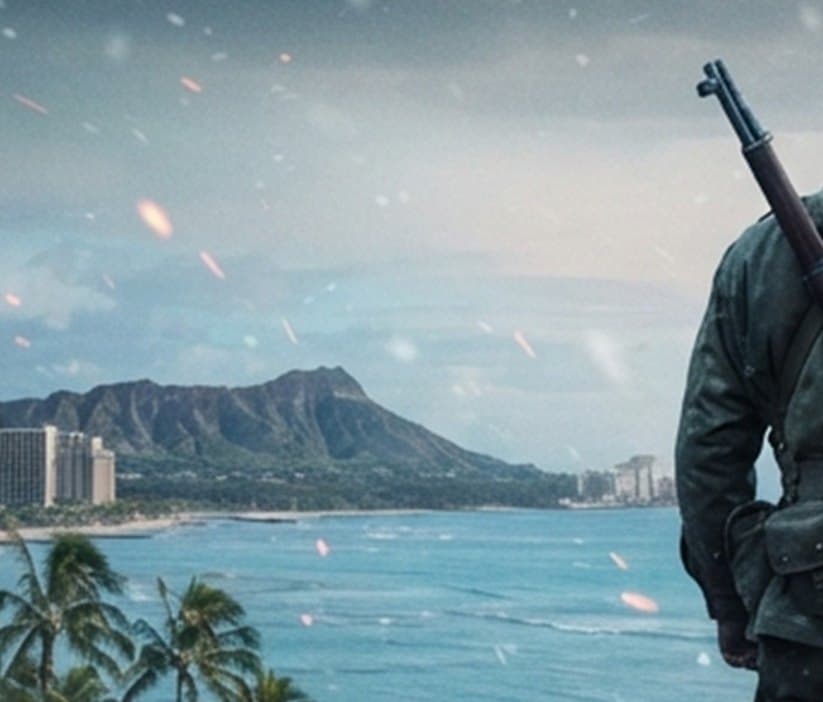
1950
Thirty-some of them raised their right hands together.
They swore in at the Ala Moana U.S. Army Recruiting Station — in from every point of the Islands, standing in a line that had never existed before that morning and would never exist again in quite that shape. Bill's serial number was 10104686. Leroy's was 10104661. Twenty-five numbers apart, because they enlisted side by side.
Then they loaded us onto a bus, and something strange happened: nobody said a word. Thirty-some young men, most of us strangers to each other an hour earlier, sitting elbow to elbow, and not one of us opened his mouth the entire ride.
1950
Quad E, second floor, 1st Platoon, Company B.
Pineapple fields ran past the bus windows as far as the eye could see, and then Schofield appeared like its own small city dropped into the middle of all that green. The first week wasn't training. It was becoming someone else. Everything olive drab, down to the boots, until every one of them was the same color head to foot — and then the clippers, and a result they called a haircut.
Nobody wanted to go home looking like that. So nobody did. It turned out we didn't need to be restricted to post to keep us there — our own reflections took care of it.
Late 1950
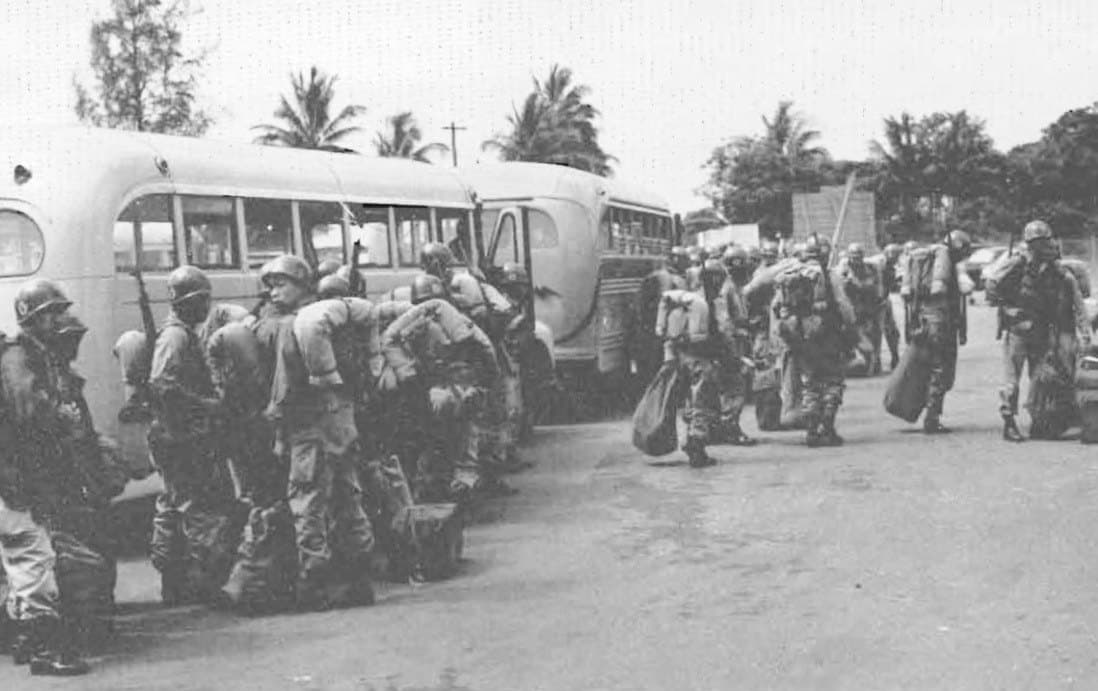
The alert that wasn't a drill.
Four or five times the alarm had gone, and every time it was the same shape: full gear, trucks, the tarmac at Hickam, hours of standing around waiting for an airplane that never came. You learn to treat a drill like a drill. That was their mistake, and it was an easy one to make, because every single time before this one, that's exactly what it had been. They slipped the fence in Aloha shirts pulled over fatigue trousers and combat boots and went into town.
An hour earlier, I'd been standing in a basement bar on King Street listening to my best friend sing about a doggie in a window. Now I was climbing into an airplane with a rifle in one hand, and my whole life in the other, and there hadn't been so much as a minute in between to get ready for the difference.
January 1, 1951
Breakfast, three times, across a date line.
They came down at Johnston Island and it was bacon and eggs. They came down at Midway certain it had to be lunch by now, and it was breakfast again. By the third stop nobody even asked. They just laughed and ate the eggs. Somewhere in the dark they crossed the International Date Line and lost a whole day of their lives to it.
“I don't know who I love more,” Leroy said, shaking his head like it was a real crisis, “your sister Virginia or Betty Lou.” We both busted out laughing so hard the whole row turned to look at us.
January 1951
Island boys, seeing snow for the first time.
The bus let them out in front of a huge building and they immediately picked up snow, rubbed it in their cold hands, and started throwing it at each other, just like the kids that they were. Then they looked up and read what was painted above the main door, big enough to see from the street.
“THROUGH THESE DOORS PASS THE GREATEST FIGHTING MEN IN THE WORLD.” I felt something run straight up the back of my neck reading it — what we call chicken skin back home — and I wasn't the only one.
January 1951
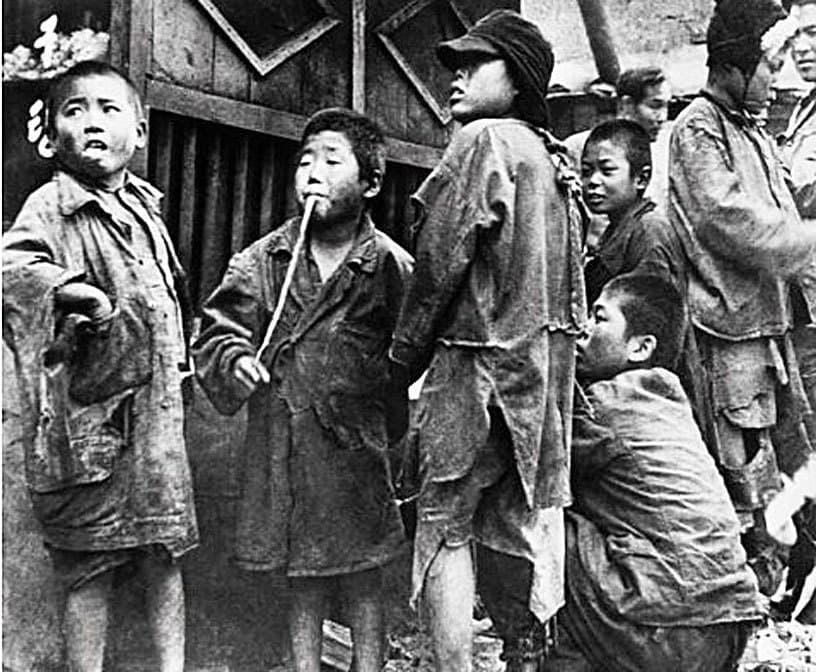
First glimpse of hell.
They came in in the dark, early morning, the cold already cutting through everything Japan had issued them. On the walk back from the mess hall, a hundred or more children swarmed toward them, hands out — clothes so torn you couldn't tell what color the fabric had started as, bones visible right through the skin. Every man in the column emptied his pockets into the street. It didn't feel like enough. It wasn't enough.
“They are what this war produces,” our guide said. “Orphans. They lost everything, including their parents and have nothing but each other.”
Spring 1951
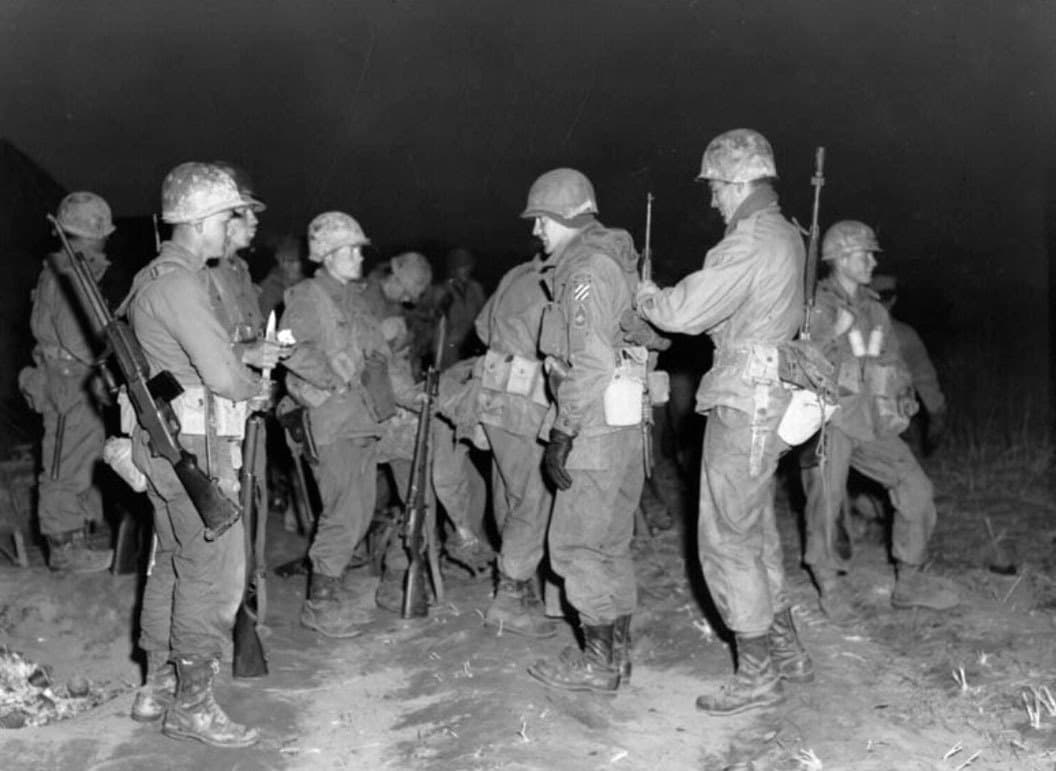
1st Battalion, 15th Infantry Regiment, 3rd Infantry Division.
They were split across three rifle companies before any of them had fired a shot in anger — Bill and Abel to Company C, Joe and Leroy to Company B, Louis to Company A. The jeeps turned around and drove back down and there wasn't another vehicle in sight. From there on they walked everywhere the jeeps couldn't go, which in Korea's frozen hills turned out to be almost everywhere.
Every single time I slipped and fell, some wise guy behind me would call out, “There goes another Hawaiian, biting the snow.”
May 22, 1951
A nineteenth birthday, mentioned on the walk home.
What they call hills on the western side of Korea, they should have called something else. A contact-and-report-back patrol went north to find the enemy without being seen, and found a valley full of tents, vehicles and close to a thousand men under a flag on a pole. Roy called it in from the Field 300 on his own back. Then the F-80s came over so low that every man on that hill drove his face into the dirt without deciding to.
“By the way, guys,” I said. “Today is my nineteenth birthday.” — That is how old I was, and that is what I was doing. Both of those things were true at the same time.
June 23–24, 1951
Two enemy battalions. Three rifle companies.
Over two thousand men thrown at three rifle companies that between them didn't add up to five hundred. Nobody needed a number to know it was bad; you could feel it in how the ground sounded. Abel went down to a sniper on the first evening. At two in the morning the bugles started, and then the flares, and Leroy stood up on that hillside with a Browning Automatic Rifle against his hip and held the trail so the rest of them could get off the mountain.
And then the whole world went white and loud all at once, and when the light and the noise cleared, there was a hole in the hillside where Leroy had been standing.
After thirteen months
Among the first to rotate out of the Division.
Roughly two hundred troops from every unit of the Division stood at the 3rd Division Replacement Center while the Commanding General gave his farewell address. At the end of it, he singled out a small group of Hawaiians who had volunteered from their beautiful Islands to join his Division, and thanked them for the fierce fighting force they had contributed — after they learned how to walk on the snow and ice.
The whole group laughed loud, then just as loud applauded.